


Have you ever stood on a mountain pass at 17,000 feet and felt completely alone with the Andes? That’s the Ausangate Trek.
Planning a high altitude trek in Peru can feel like a lot. Altitude sickness is real. The weather can shift in minutes. And the numbers, passes above 5,000 meters, temperatures below negative 10 degrees Celsius at night, can seem intimidating at first glance.
Need Quick & Easy Trip Planning? We Can Help..


Free Itineraries Based on your Schedule & Budget
Booking Assistance for Hotels, Flights and Transfers
24/7 Customer Support & Personal Travel Advisors
Here’s what we’ve found after guiding groups through this route: the Ausangate Trek is actually more rewarding than the famous Inca Trail, even though it asks more from your body. The mountain stands at 6,384 meters, and locals revere it as an Apu, a protective spirit that watches over the entire Cusco region.
We want to walk you through everything, the five-day circuit, how to handle extreme altitude, how to combine this with Rainbow Mountain, and what gear you actually need to stay warm and safe.
This is your complete Ausangate trek guide. Pull up a chair and let’s go through it together.
Paracas National Reserve Table of Contents
Ausangate Key Takeaways
- The Ausangate Trek reaches 5,200 meters across five days, making it harder than the Inca Trail but more rewarding with fewer crowds and no permits required.
- Trek between May and October during dry season; avoid November through April when rain makes passes dangerous and trails nearly impassable.
- Spend at least three days acclimatizing in Cusco before starting; altitude matters more than fitness, and guides carry emergency oxygen for safety support.
- Pack a sleeping bag rated for negative 15 degrees Celsius, down jacket, waterproof boots, and SPF50 sunscreen because night temperatures drop below negative 10 degrees Celsius.
- Karikuy guided tours cost around $609 per person and include meals, horses, professional guides, cooks, camping gear, and emergency oxygen for the complete five-day circuit.

What Is Ausangate?

Ausangate rises 6,384 meters (20,945 feet) above sea level in the Vilcanota mountain range, sitting about 100 kilometers southeast of Cusco. It ranks as the fifth-highest peak in Peru, and locals know it as an Apu, a sacred mountain spirit that governs the well-being of Andean communities.
The name comes from Quechua. Some translate it as “sacred Apu,” while others interpret it as “the one that gives life,” which tells you exactly how the Ausangate Runas herders who live in its shadow see this mountain. It’s not just geology. It’s the center of their world.
According to Andean belief, Apu Ausangate is considered the owner of the entire Cusco region. Communities make offerings to this mountain for safe passage, good weather, and plentiful harvests. That spiritual weight makes every step on this circuit feel different from other high-altitude treks.
The Qoyllur Riti Festival
Every year, the Qoyllur Riti festival draws over 10,000 pilgrims to the Sinakara Valley near Ausangate. Recognized as a UNESCO Intangible Cultural Heritage, this extraordinary gathering blends Catholic devotion with ancient Andean traditions at an elevation of over 4,600 meters.
The name “Qoyllur Riti” translates from Quechua as “Snow Star,” referring both to the brilliance of Venus rising above the glacier and to the sacred ice of Ausangate itself. The festival happens in late May or early June, aligned with the Andean ritual calendar just before Corpus Christi. Pilgrims organize into groups called naciones, each representing a different region, and they walk for days to reach the Sinakara Valley sanctuary.
One of the most compelling figures of the pilgrimage is the Ukuku, a half-man, half-bear dancer who serves as guardian of the ritual. Historically, these figures climbed the glaciers to retrieve sacred ice and carry it back to their villages as a blessing. It’s a pilgrimage that blends Andean and Christian traditions unlike anything else in South America.
Rainbow Mountain and the Wider Landscape
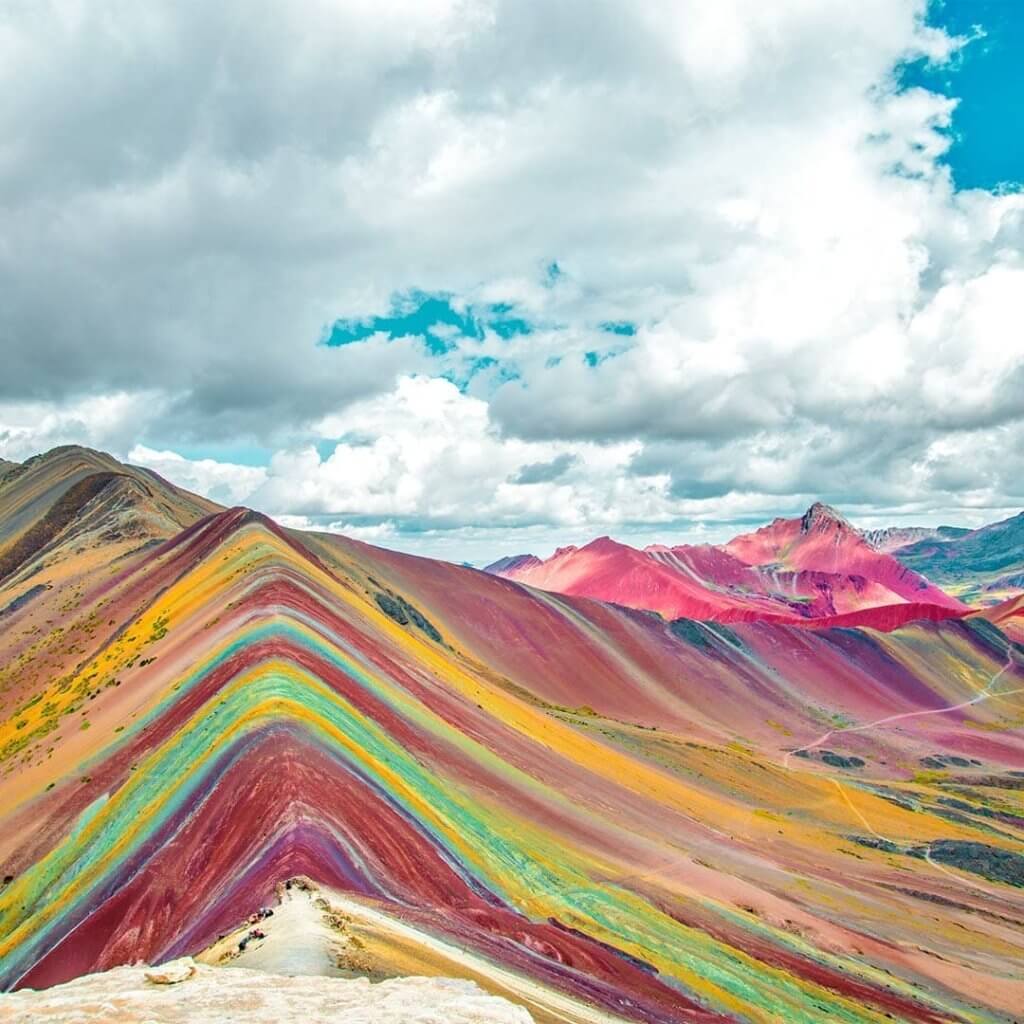
Rainbow Mountain, also called Vinicunca, sits at the edge of the Ausangate massif at 5,200 meters. Mineral stripes paint the mountainside in brilliant reds, yellows, and purples, and those colors come from geological layers exposed by erosion over millions of years, not paint.
The Ausangate Glacier creates stunning ice formations throughout the trek. Vicunas roam the high slopes freely. Condors soar overhead. Flamingos gather near glacial lakes. This landscape represents the heart of Andean religion and cosmology, and we get to walk through all of it on the Cordillera Vilcanota circuit.
Ausangate vs. the Other Famous Treks in Peru
We’ve guided groups on Peru’s most famous trails, and Ausangate stands apart from the rest. The key question isn’t which trek is harder. It’s which trek matches what you’re actually looking for.
The Ausangate Trek never drops below 4,300 meters (14,100 feet) during the entire circuit, and its passes push over 5,200 meters. That sustained altitude is what separates it from every other route in the region.
| Feature | Ausangate | Salkantay | Inca Trail |
|---|---|---|---|
| Max Elevation | 5,200 m (17,060 ft) | 4,630 m (15,190 ft) | 4,215 m (13,828 ft) |
| Permit Required | No | No | Yes, books out 4-6 months ahead |
| Duration | 5 days standard | 5 days typical | 4 days classic |
| Difficulty | Hard to very hard | Moderate to hard | Moderate |
| Crowd Level | Very low | Moderate | High (permit-controlled) |
| Ends at Machu Picchu | No | Yes | Yes (via Sun Gate) |
Choose Ausangate if you want solitude, high mountains, and nature untouched by mass tourism. Choose Salkantay if you want diverse scenery and a path to Machu Picchu without permits. Choose the Inca Trail if you value history, Inca ruins, and arriving at Machu Picchu through the original stone pathways.
Ausangate 5 Days: 5,200m, Hard, No Permit, Pure Wilderness
The five-day Ausangate circuit stands apart because it demands more from us than the Inca Trail or Salkantay, yet rewards us with raw wilderness that very few tourists ever see. Only about 5% of hikers on this route do it solo, according to trekkers who have completed the circuit. The other 95% go with guides, and for good reason.
We climb to 5,200 meters at Palomani Pass on Day 3. No permits block our path, which means we trek through genuine backcountry without the crowds. The 70-kilometer route takes us past glacial lakes, through valleys where vicunas roam freely, and across passes that test our bodies and spirits alike.
Most of us need two to three days in Cusco first to let our bodies adjust before we start. The CDC’s Yellow Book on altitude travel recommends acclimatizing at a mid-level altitude, like Cusco at 3,400 meters, before ascending higher. Don’t skip that step.

Inca Trail: 4,215m, Moderate, Permit Required, Ruins
If Ausangate feels like climbing into the sky itself, the Inca Trail offers a different kind of magic, one wrapped in history and ancient stone. The Inca Trail is a UNESCO World Heritage Site and part of the Qhapaq Nan, the Inca road network that ran through six countries.
The Inca Trail is the only route that lets you enter Machu Picchu through the historic Sun Gate at sunrise, which is an experience no other trek can replicate.
Permits are mandatory and sell out four to six months ahead during peak season. The system limits daily hikers to 500, which protects the trail. Many of us prefer the Inca Trail for first-time high-altitude trekking because the lower elevation at 4,215 meters means less risk of altitude sickness. Acclimatizing in Cusco for at least 48 hours before starting handles most altitude-related issues.
Pack a sleeping bag rated for -10 degrees Celsius minimum. The nights near 4,215 meters can surprise unprepared hikers. Thermal layers, waterproof boots, and trekking poles are all critical. Apply SPF 50 sunscreen liberally; the sun reflects intensely above 4,000 meters and can burn exposed skin within minutes.

Salkantay: 4,630m, Moderate-Hard, No Permit, Scenery
If you want something different from the Inca Trail but still crave dramatic mountain views, Salkantay trekking offers a solid middle ground. This route reaches 4,630 meters, which sits lower than Ausangate but significantly higher than the classic Inca ruins trail.
We skip the permit hassle entirely, giving us more freedom. The scenery here is diverse: snow-capped peaks, turquoise lakes, and lush cloud forests appear as we move through different elevation zones. The Salkantay Trek is recognized by National Geographic as one of the world’s best treks, which tells you something about the quality of what’s on offer.
Spending at least 48 hours in Cusco first prevents altitude sickness from ruining the experience. Temperatures swing from 35 degrees Fahrenheit during the day to freezing at night, so layering matters.

Rainbow Mountain: 5,200m, Moderate, Day Trip Option
Rainbow Mountain, or Vinicunca, sits at the edge of the Ausangate massif at 5,200 meters. We can tackle this colored peak as a separate day tour from Cusco, or combine it with Day 5 of our five-day trek.
One important thing to know: local authorities have reported peak-season visitor counts reaching 1,000 to 1,500 people per day at Vinicunca. That’s a lot of people at over 5,000 meters. Tours that depart around 3:00 to 3:30 AM from Cusco consistently report thinner crowds and better visibility at the summit. Early morning is the strategic move here.
We’ve found that combining Rainbow Mountain with the seven lakes option creates an unforgettable adventure. Flamingos gather at the glacial lakes nearby, and condors soar overhead as we climb higher. Our Karikuy tours include transport from Cusco, a knowledgeable guide, and all entrance fees.
Pack SPF 50 sunscreen and spend 48 to 72 hours in Cusco first to acclimatize properly. The altitude matters more than the hiking distance here.
The 5-Day Ausangate Trek Circuit
If you want more adventure than a day trip offers, the 5-day Ausangate trek circuit delivers the full experience. We cover approximately 42.8 miles across five days, gaining 9,406 feet of elevation as we circle this sacred mountain.
The trek starts in Tinki at 12,498 feet and pushes us to Palomani Pass, the highest point at 16,828 feet on Day 3. No permits are needed, which means we skip the bureaucracy and head straight into the wilderness.
- Day 1: 7.5 miles from Tinki to Upis (hot springs camp at 4,400 m), gaining 2,346 feet
- Day 2: 10.25 miles to Pucacocha, climbing 2,946 feet through alpine meadows past glacier lakes and vicunas
- Day 3: 7.3 miles to Jampa, gaining 2,093 feet to summit Palomani Pass at 5,200 m with condors overhead
- Day 4: 10.6 miles to Pacchanta, gaining 2,073 feet through glacial lakes and strong winds
- Day 5: 7-mile walk back to Tinki, gaining just 272 feet before transferring to Cusco
Our Karikuy Ausangate Trek 5 Days package includes camping gear, all meals, horses to carry supplies, a professional guide, a cook, and emergency oxygen. We arrive acclimatized, prepared, and ready to tackle what many consider harder than the Inca Trail itself.
Day 1: Cusco to Tinki (3,900m) and Upis Hot Springs (4,400m)
Our Ausangate trek begins with a scenic two-hour drive from Cusco to the village of Tinki, which sits at 3,900 meters. We leave the city behind and head southeast into the Quispicanchi province, where the landscape shifts dramatically.
The road winds through traditional Andean villages. Our guide points out local llamas grazing on hillsides, and we catch our first glimpses of the mountain terrain ahead. The drive itself gives our bodies a gentle warm-up at elevation before the real climbing begins.
After arriving in Tinki, we hike up to the Upis hot springs at 4,400 meters. The trail climbs steadily but remains manageable on this first day. The Upis community at this elevation offers lodging and meals for travelers who choose that option, and its inhabitants maintain ancestral traditions connected to the Ausangate glaciers above.
We reach the geothermal pools in the late afternoon. Soaking in these natural hot springs feels incredible after hours of travel. The warm water contrasts sharply with the cool mountain air, and we relax while gazing at the peaks surrounding us.
That night, we camp near the springs and rest well. The real adventure starts tomorrow when we tackle the higher passes and glacier lakes.

Day 2: Arapa Pass (5,050m), Glacier Lakes, Vicunas
Day 2 hits different. We climb toward Arapa Pass at 5,050 meters, leaving the lower camps behind as altitude starts to feel real. The trail winds through rocky terrain, and our guides keep the pace steady.
Glacier-fed lakes appear like turquoise jewels scattered across the landscape. Vicunas, those wild relatives of llamas, graze nearby in small herds, unbothered by our presence. These graceful animals roam freely across the high plains, and spotting them makes the hard work feel worth it.
We stop frequently to catch our breath and soak in the views. Rushing at this elevation is a recipe for trouble. Reaching Arapa Pass itself brings a real rush of accomplishment. We stand above 5,000 meters now, surrounded by glaciers and mountain peaks that stretch endlessly.
This is where the Ausangate circuit separates the casual hikers from the serious adventurers. Trekking poles become our best friends on the descent, saving our knees as we drop into the next valley. The day ends with tired legs but energized spirits.
Our guides carry emergency oxygen, so we trek with confidence despite the serious altitude.

Day 3: Palomani Pass (5,200m), Highest Point, Condors
Day 3 pushes us to our limits as we tackle Palomani Pass, the trek’s highest point at 17,000 feet. We witness Andean condors soaring above glacial valleys while our bodies deal with extreme altitude.
- We start early from our glacier lake camp, climbing steeply toward Palomani Pass through thin mountain air. Trekking poles become our best friends on this challenging ascent.
- Our guides carry emergency oxygen at this elevation, ready to help anyone struggling with acute mountain sickness. Karikuy’s experienced team knows these passes intimately.
- We reach 5,200 meters, standing at the highest point of our entire Ausangate trek. The view stretches across the Andes in all directions.
- Condors glide past us on massive wings, riding thermal currents above the pass. These magnificent birds represent the sacred Apu Ausangate in Andean cosmology.
- We pack thermal layers and down jackets for the cold, as night temperatures drop below negative 10 degrees Celsius. SPF 50 sunscreen protects our skin from intense high-altitude UV rays.
- Our cook prepares hot meals at camp to fuel our bodies for this demanding day. Proper nutrition matters more than fitness at this altitude.
- We descend gradually toward Ausangate Lake on the far side, giving our legs a break from climbing. The glacial scenery surrounding us feels otherworldly and sacred.
- We’ve acclimatized for three days since leaving Cusco, making this push possible. Physical training six to eight weeks before arriving also helps tremendously.
- Our Garmin devices track our progress across this remote section of the Quispicanchi Province landscape. We stay connected to safety resources throughout the day.

Day 4: Ausangate Lake, Glacial Scenery, Lake Camping
Day 4 brings us to Ausangate Lake, where glacial scenery surrounds our camp and the mountain reveals its raw power. We pitch our tents right beside the lake, and the landscape takes our breath away, literally and figuratively.
Towering glaciers feed the water with icy melt, creating that brilliant turquoise color we’ve all seen in photos. Our guide and cook prepare meals while we explore the shoreline, spotting vicunas grazing on sparse alpine vegetation.
The air feels thin at this elevation, but the views make every labored breath worthwhile. We settle in for the night under stars so bright they almost hurt to look at, and the temperature drops below freezing as darkness falls.
Our camp sits within the Ausangate massif, surrounded by peaks that touch the sky. We wake early to catch the sunrise painting the glaciers gold and pink, a moment that makes all the trekking pain vanish instantly.
The lake reflects everything perfectly, creating a mirror image of the mountains above. Some of us hike to nearby viewpoints to photograph the glacial formations, while others rest and prepare for our descent tomorrow. This is where the Ausangate trek truly rewards us for the effort.

Day 5: Return to Tinki, Transfer to Cusco
Our final day arrives with mixed emotions. We pack up camp at Ausangate Lake and begin our descent back toward Tinki, retracing some familiar terrain but seeing it with fresh eyes.
The downhill trek feels easier on our legs, though altitude still affects us as we drop from our high camp. Glacial views fade behind us as we move lower into the valley. Our guide leads us steadily, and our horses carry the heavier gear, making the journey manageable.
We reach Tinki by early afternoon, having covered significant ground since dawn. Our transport waits to carry us back to Cusco, a two-hour drive southeast through the Andes. We settle in for the ride, watching the landscape shift from high altitude terrain to lower elevations.
Our bodies feel the effects of five days at elevations reaching 17,000 feet and gaining 9,406 feet total. The drive gives us time to reflect on passes like Palomani at 5,200 meters and the vicunas we spotted along the way. We arrive in Cusco by late afternoon, ready to rest and recover from this 42.8-mile adventure.

Karikuy Ausangate Trek 5 Days: What’s Included
We pack everything you need for five days in the Andes, so you can focus on the adventure. Our Karikuy Ausangate Trek 5 Days package includes a professional guide, an experienced cook, camping equipment, all meals, and horses to carry your gear.
You start from Cusco and head southeast to Tinki at 3,900 meters, then push through high passes over 5,000 meters like Arapa Pass and Palomani Pass. The trek covers 43 miles total, with elevations reaching up to 17,000 feet at Palomani Pass on Day 3.
Your guide carries emergency oxygen for altitude concerns, and we provide everything from thermal waterproof clothing recommendations to high-SPF sunscreen guidance for the intense mountain sun.
Costs run around $609 per person for the full package. We handle the logistics so you experience Peru’s most sacred mountain without stress. Each day brings you closer to Ausangate’s glacial lakes and the chance to spot vicunas grazing at high altitude.
The cook prepares hot meals at camp, warming you after cold nights that drop below negative 10 degrees Celsius. Your horses move at a steady pace, so acclimatization matters more than raw fitness. We recommend spending three days in Cusco before starting.
May through September offers the best conditions during the dry season, with daytime temperatures between 10 and 20 degrees Celsius. Contact Karikuy directly for availability and to reserve your spot on this transformative journey through the heart of Andean wilderness.
Ausangate 7 Lakes Day Tour
If a full multi-day trek feels too demanding, we offer the Ausangate 7 Lakes Full Day tour as an excellent alternative to the five-day expedition. This one-day hike departs from Cusco each morning and returns the same evening, making it perfect for travelers with limited time.
Our guides transport you to Cusipata at 3,980 meters, then lead you on foot through the Vilcanota Mountain Range to explore seven stunning glacier lakes. The hike takes place between 4,500 and 4,900 meters above sea level, so altitude affects most visitors more than the actual walking distance.
Throughout the day, you’ll spot wild vicunas grazing near turquoise and emerald lagoons, flamingos wading in shallow waters, and Andean ichu grass swaying across high-altitude meadows. Yareta plants, lichens, and mosses cling to rocky slopes around each lake.
Our package includes all transport from Cusco, a professional guide, and entry fees. This day tour works wonderfully as a standalone adventure or as part of your responsible travel plans through the Antisuyo region.

Rainbow Mountain at Ausangate
Vinicunca sits at the edge of the Ausangate massif, rising 5,200 meters above sea level with stripes of red, yellow, and green mineral deposits painted across its slopes. We can reach this spectacular mountain as a standalone day tour from Cusco or combine it with Day 5 of our Ausangate Trek.
The vibrant colors come from natural mineral deposits laid down over millions of years. Geological layers exposed by erosion created this effect, not any kind of artificial coloring. Early morning visits work best. The light between 8:00 and 10:00 AM brings out the stripes most vividly, and that’s exactly when early-departure tours arrive before the main crowd wave.
Giant Hummingbirds dart through the thin air, while Andean Condors soar overhead with their massive wingspans, making the experience feel truly wild and remote. Our journey to Rainbow Mountain takes us through the Red Valley, also called the Red Canyon of the Andes, where elevations hover above 4,900 meters.
We recommend spending at least three days in Cusco before starting any high-altitude adventure in this region. A Sacred Valley day trip beforehand also helps our bodies adjust to thin air.

Combine Trek Day 5 or Book a Separate Day Tour
Rainbow Mountain, or Vinicunca as locals call it, sits right at the edge of the Ausangate massif and offers one of Peru’s most jaw-dropping photo opportunities. This mountain reaches 5,200 meters and displays colored mineral stripes that look like nature painted them with every crayon in the box.
We can tackle this sight in two ways: combine it with Day 5 of our trek, or book a separate day tour from Cusco that gets us back the same afternoon. Travelers who want to keep the five-day itinerary intact can also arrange their own transportation from Tinki back to Cusco and visit Vinicunca as a separate trip.
One insider tip worth knowing: tours that pick up around 3:00 to 3:30 AM consistently reach the summit before the main wave of visitors. Trekkers who arrived before 9:00 AM reported thinner crowds and better visibility than those arriving after 10:30 AM, according to traveler surveys on the route. Early is the smart play.
Bring a camera, sunscreen rated SPF50, and plenty of water. The altitude hits hard up there, but the reward is one of the most extraordinary landscapes on Earth.
Altitude and Difficulty on the Ausangate Trek
We won’t sugarcoat this: the Ausangate Trek tests your body in ways other trails simply don’t. All passes sit above 5,000 meters, with the highest point reaching 5,200 meters on Day 3 at Palomani Pass.
That elevation crushes many trekkers. We’ve seen ultra-marathoners struggle while casual hikers thrived, all because their bodies adapted better to the thin air. Altitude matters far more than raw fitness on this circuit.
The CDC’s Yellow Book on high-altitude travel notes that the human body can adjust to altitudes up to approximately 5,200 meters, but it requires time to do so. That acute adjustment process over the first three to five days after arrival is crucial for anyone heading to Ausangate’s high passes.

All Passes Above 5,000m: Harder Than the Inca Trail
We climb higher on the Ausangate trek than most people expect. Palomani Pass hits 5,165 to 5,200 meters, making it the highest point on Day 3. Qampa Pass sits at 5,000 meters, and Puca Cocha Pass reaches 5,051 meters. Every single pass on this circuit exceeds 5,000 meters.
That separates this trek from easier routes like the Inca Trail, which maxes out at 4,215 meters. We’re dealing with roughly 1,000 meters more altitude here. That extra elevation changes everything about how our lungs work and how our heads feel.
This trek demands more from us than Salkantay, which peaks at 4,630 meters. Our legs might feel strong, yet our lungs might struggle. We recommend spending at least three days in Cusco before starting, with a Sacred Valley day trip if possible. Karikuy guides carry emergency oxygen on every trek, which gives us real peace of mind at those extreme elevations.
Sacred Valley Day Trip Recommended
Your body needs time to adjust before tackling those brutal passes above 5,000 meters. We recommend spending at least three days in Cusco, the ancient capital of the Tahuantinsuyo empire, to let your system acclimate to the thin air.
This gives us a real chance to avoid altitude sickness when we hit Palomani Pass at 5,200 meters on Day 3. Cusco sits at 11,000 feet, so our lungs start working harder the moment we arrive. Taking walks around the city, staying hydrated, and eating light meals all help.
A day trip through the Sacred Valley strengthens our acclimatization even more. We can visit the terraces at Moray, the salt ponds at Salineras, or the ruins near Urcos without pushing ourselves too hard. These sites sit between 9,000 and 12,000 feet, creating a perfect stepping stone before we tackle the Ausangate circuit.
Starting the Ausangate Trek 5 Days after proper acclimatization sets us up for success. Prevention beats rescue every time.

Contact Karikuy for Availability
We’ve laid out everything you need to tackle Peru’s most sacred mountain, and now the choice is yours. Ausangate rewards those brave enough to push past 5,200 meters with glaciers, wild vicunas, and views that stay with you long after you return to sea level.
Contact Karikuy for availability on the 5-day trek, the 7 Lakes day tour, or a combo that throws Rainbow Mountain into the mix. Your adventure starts the moment you decide to stop reading and start packing.
Ausangate Trek FAQ
What is the Ausangate Trek, and who leads guided tours?
We always point our hikers to Killa Expeditions, a fantastic team that leads high-altitude routes up to 17,716 feet. Travel photographers like Quin Schrock and Alison MacAllister have shared their incredible photos of this remote path, making it easier for us to show you exactly what to expect.
Is the Ausangate Trek listed on All Trails?
Yes, you can pull up the exact GPS route on All Trails, which is super helpful since this hike is much higher and steeper than anything on the Appalachian Trail. Our friend Drew Robinson uses it to track his mileage and read recent trail conditions before we head out.
What towns should I visit near the Ausangate Trek?
Tingui is your main starting point, but we also love taking our groups to explore the ancient salt mines in Maras and the impressive Pachacútec monument before the hike. If you time your trip right, you can experience the massive Qoyllur Rit’i festival, a sacred Qoyllur Rit’i gathering of over 10,000 people, or add a quick train ride to see Macchu Pichhu.
Where can I stay near the Ausangate Trek?
We highly recommend booking a room at Hospedaje Turistic Recoleta, where our favorite local host, Jose, makes sure you are rested and fed before hitting the trail.
Do I need travel insurance for the Ausangate Trek?
We strongly suggest picking up a policy from Safety Wing Insurance because standard US plans often exclude extreme elevations. Their Adventure add-on protects you up to 6,000 meters, giving our team total peace of mind in the remote Andes.

Angel Ponce
Ángel is a passionate traveler and cultural enthusiast with over 5 years of experience in the tourism sector in Peru. Originally trained in Administration, he is currently expanding his expertise by specializing in Software Engineering, combining his love for travel with a growing passion for technology.
Born and raised in Peru, Ángel has always been fascinated by his country's rich cultural heritage, diverse landscapes, and especially its world-renowned cuisine. His early experiences exploring Peru include climbing the majestic Pastoruri Glacier as a child—a memory that sparked his lifelong connection to the country's natural beauty. Today, he enjoys exploring Peru’s coastal gems and sharing his insights with fellow travelers.
Ángel is deeply knowledgeable about Peru's history, traditions, and hidden cultural treasures. He enjoys creating meaningful travel experiences that help visitors connect with the authentic soul of the country. In his free time, you'll often find him diving into programming books, continuously learning and merging his two great passions: technology and travel.
With a unique blend of local expertise, cultural appreciation, and technical skills, Ángel brings a fresh and insightful perspective to Peru’s travel industry.
- Angel Ponce

- Angel Ponce

- Angel Ponce

- Angel Ponce


